California is preparing for a major shift in traffic enforcement as the state begins allowing law enforcement agencies to formally issue citations and notices of noncompliance involving autonomous vehicles. Beginning July 1, 2026, police officers will finally have a legal process for addressing traffic violations involving self-driving cars operated by companies like Waymo, Zoox, and other autonomous vehicle manufacturers.
For years, one of the strangest legal gray areas in California traffic law involved a simple question: what happens when a car breaks the law, but nobody is behind the wheel?
As autonomous vehicles became increasingly common in cities like San Francisco, Los Angeles, and parts of Silicon Valley, reports involving driverless vehicles committing traffic violations or creating roadway disruptions continued to grow. But under existing law, officers often had limited ability to issue citations because California’s traffic enforcement system was still largely designed around human drivers.
That is now changing.
California’s New Driverless Car Enforcement Rules
Under Assembly Bill 1777, California officers may issue what are known as “Notices of AV Noncompliance” when autonomous vehicles violate traffic laws or interfere with emergency operations. Instead of handing a ticket to a driver, officers will document the alleged violation and forward the report to the California DMV, which can then investigate and potentially penalize the autonomous vehicle operator.
The new regulations may apply to incidents involving:
- speeding
- illegal turns
- running stop signs
- blocking intersections
- failure to yield
- stopping in restricted zones
- interfering with emergency responders
The law also imposes new safety requirements on autonomous vehicle companies, including emergency communication systems, first responder coordination rules, and stricter testing standards.
Driverless Cars Have Already Been Accused of Illegal Driving Behavior
The legal changes come after years of increasingly public incidents involving autonomous vehicles behaving unpredictably on California roads.
One of the most widely discussed examples involved Waymo robotaxis allegedly making illegal U-turns and stopping unexpectedly during traffic operations in San Francisco. In one incident during a Bay Area DUI enforcement operation, officers reportedly pulled over a Waymo vehicle after it performed an illegal maneuver, only to discover there was no driver inside the car. Officers later joked publicly that their citation books did not even contain a category for autonomous vehicles.
San Francisco residents have also repeatedly complained about driverless vehicles:
- freezing in traffic
- blocking intersections
- creating congestion
- stopping suddenly for no obvious reason
- interfering with cyclists and pedestrians
Some residents interviewed in local media described Waymo vehicles becoming confused in dense city traffic or creating hazardous conditions in busy urban areas.
In another widely reported case, autonomous vehicles reportedly interfered with emergency response operations in Austin after a Waymo taxi became stuck while attempting a U-turn near an active shooting scene, temporarily blocking roadway access for emergency vehicles.
Federal regulators have also investigated incidents involving autonomous vehicles allegedly:
- driving on the wrong side of the road
- colliding with gates or fixed objects
- striking cyclists
- creating roadway hazards
- failing to properly respond to traffic conditions
The National Highway Traffic Safety Administration has reviewed multiple incidents involving autonomous vehicle systems in recent years.
San Francisco Became Ground Zero for Driverless Car Controversy
Much of the backlash surrounding autonomous vehicles has centered around San Francisco, where robotaxis became highly visible long before most legal frameworks were ready to regulate them.
Residents, city officials, cyclists, emergency responders, and transit advocates have repeatedly raised concerns about autonomous vehicles obstructing traffic lanes, stalling during emergencies, and operating unpredictably in dense urban environments.
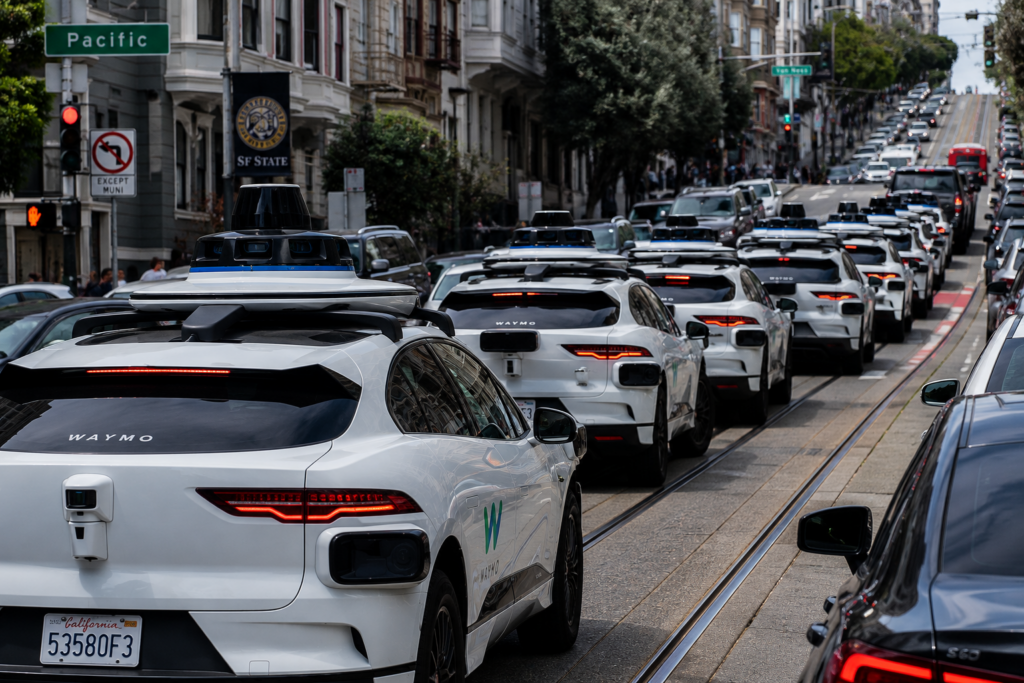
Back in October 2025 a group of techy pranksters caused a traffic jam with upto 50 driverless cars.
In December 2025, Waymo service was discontinued after a blackout caused traffic jams.
At one point, San Francisco officials even attempted to slow the expansion of autonomous vehicle operations due to public safety concerns.
Despite the criticism, autonomous vehicle companies continue to argue that their systems may eventually reduce serious traffic accidents caused by impaired, distracted, or reckless human drivers. Some early studies suggest certain autonomous systems may have lower crash rates under limited conditions, although researchers caution that current datasets remain relatively small and difficult to compare directly against human driving.
Who Is Actually Responsible When a Driverless Car Breaks the Law?
That question remains one of the biggest unresolved issues surrounding autonomous vehicles.
Unlike traditional traffic violations, driverless vehicle cases may involve:
- software developers
- remote operators
- fleet management systems
- vehicle manufacturers
- corporate entities
- insurance carriers
rather than an individual driver.
The legal system is still evolving to determine how fault, negligence, and liability should apply when artificial intelligence is controlling the vehicle instead of a human operator.
California’s new enforcement framework is essentially the first large-scale attempt to force autonomous vehicle companies into the same traffic accountability system that ordinary drivers have dealt with for decades.
California Traffic Law Is Entering a New Era
California has long been one of the most aggressive states when it comes to testing and deploying autonomous vehicle technology. But as driverless cars become more common on public roads, regulators are increasingly signaling that autonomous vehicles will not receive unlimited flexibility when it comes to traffic enforcement.
Whether autonomous vehicles ultimately make roads safer remains heavily debated. What is becoming increasingly clear, however, is that California no longer wants driverless cars operating in a legal gray area where traffic violations occur without meaningful accountability.
Beginning in July 2026, autonomous vehicle companies may finally start facing the same enforcement scrutiny human drivers have always dealt with on California roads.